

Growing Room Energy Intensity and Small-Calibre Deficits: Transforming Europe’s Canned Mushroom Market

Energy expenditures in European mushroom cultivation have escalated to 34–38% of total production costs, prompting growers to alter growing room microclimate settings. The resulting temperature fluctuations during peak harvesting flushes have accelerated veil opening, cutting the supply of Grade 1 closed buttons by 12–15%. This structural raw material deficit for premium whole canning is forcing processors to pivot capacity toward sliced products.
Market Reality and Scale: Shortage of Small-Calibre Closed Buttons in European Growing Rooms
Across Europe’s primary commercial mushroom cultivation hubs—Poland, the Netherlands, Germany, and France—a structural shift in the morphological yield distribution of white button mushrooms (Agaricus bisporus) has emerged. The proportion of harvested volume exhibiting an open veil (the protective membrane beneath the cap) during the second and third flushes has climbed 14–18% above multi-year averages. Concurrently, the available supply of firm, closed buttons sized 20–35 mm—the core raw material for Grade 1 whole canned mushrooms—has contracted by 12–15% year-on-year.
In parallel, electricity and growing room climate conditioning costs have solidified at 34–38% of total production cost structures, compared to historical baselines of 18–22%. This dual pressure—elevated energy expenditures combined with the loss of premium fractions—defines the present landscape: canning plants face an oversupply of open, large-calibre mushrooms (45+ mm) against an acute shortage of small, round closed caps. Consequently, processors cannot maintain scheduled throughput on whole mushroom canning lines and are forced to reconfigure operational programs in favor of sliced SKUs.
Underlying Drivers: Tariff Pressures on Climate Control and Compost Thermal Spikes
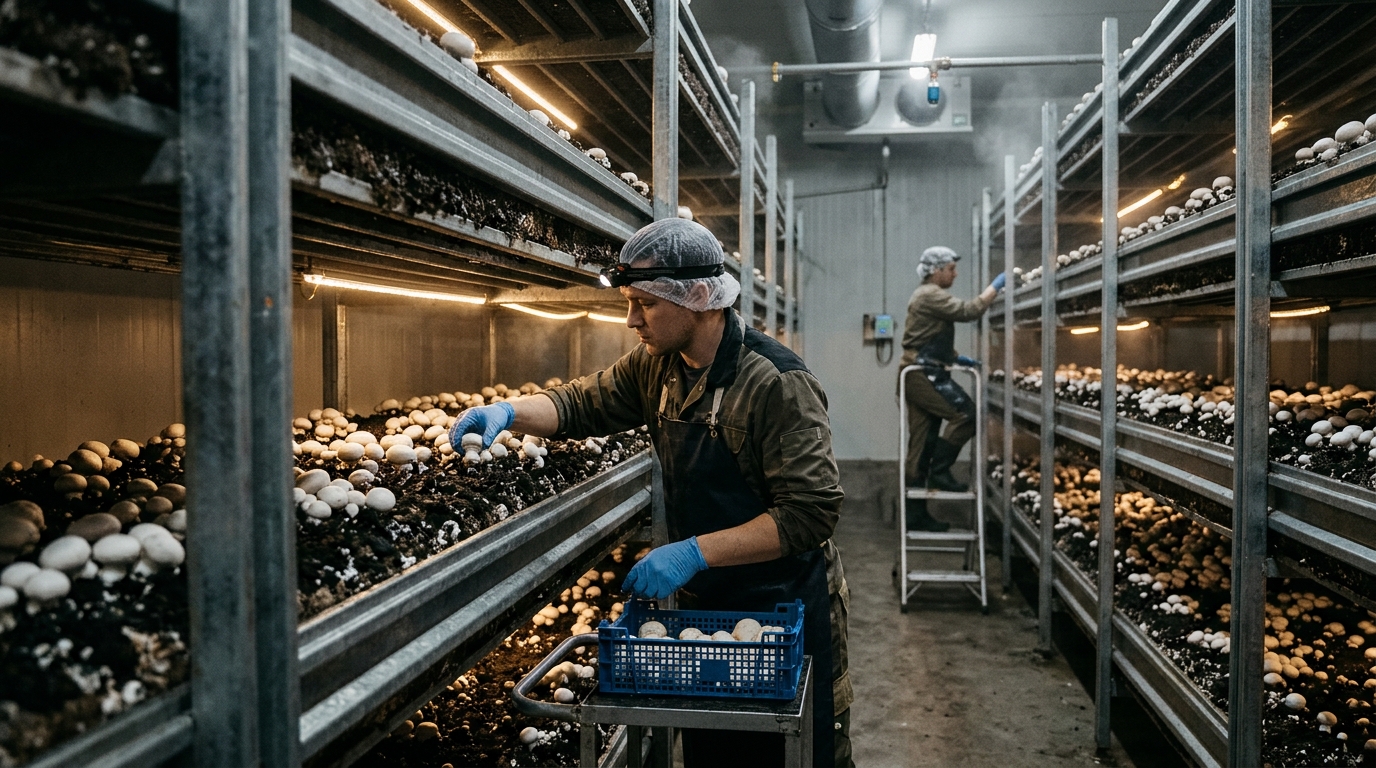
The cultivation of Agaricus bisporus demands rigorous management of exothermic biological activity. During the fruiting body formation stage, mycelium within Phase III substrate generates 250–300 W of heat per square meter of usable shelf space. Maintaining compost temperatures at 18–19 °C alongside air temperatures of 16–17 °C requires refrigeration and ventilation systems to cycle air volumes 20–25 times per hour—representing the operation’s primary energy expenditure.
Confronted by commercial peak-tariff pricing, growers have transitioned to dynamic climate control strategies: temporarily throttling compressor loads, curbing fresh air intake, and tolerating broader relative humidity fluctuations. When growing room CO₂ concentrations exceed 1,400–1,600 ppm and relative humidity dips below 84%, the fungi enter an accelerated development phase: stipes elongate, veil tension intensifies, and caps open 6–10 hours ahead of scheduled selective harvesting.
The situation is further compounded by EU regulatory constraints on high-moor peat usage in casing soil. Alternative peat-reduced blends feature divergent moisture retention properties and lower thermal conductivity, thereby steepening the temperature gradient between the shelf base and the casing surface. This makes the upper tiers of growing racks acutely vulnerable to any curtailment or deceleration in airflow velocity.
Processing Implications: Why an Open Veil Devalues Raw Material for Whole Canning
Premium-grade whole canned mushrooms strictly require intact, closed caps sized 20–35 mm. Veil rupture exposes brown gills, which leach spore pigments during retort autoclaving, discoloring the brine and downgrading the visual classification of the finished product. Furthermore, open mushrooms possess a more porous cellular structure; steam blanching results in weight losses of 28–32%, compared to 20–22% for dense, closed buttons, driving raw material consumption per unit of finished product up by 6–8%.
In response, canning facilities are adjusting their production ratios: whereas historical packing allocations maintained 60% whole buttons to 40% sliced, the whole mushroom share within processing schedules has retreated to 35–40%. This shift has generated a contractual supply deficit in the premium small-calibre canned category.
Industry Response: Tighter Tolerances, Shift to Sliced Formats, and Cooling Capex

European processors have tightened intake quality controls: inbound defect tolerances for open or deformed caps in consignments destined for premium whole canning have been lowered from 7% to 3%. Batches exceeding this threshold are systematically diverted to industrial slicing or individual quick freezing (IQF) lines.
Demand substitution is taking hold across retail and foodservice channels: international supermarket chains are expanding the shelf space dedicated to sliced canned mushrooms on planograms, while industrial end-users—pizza chains, ready-meal manufacturers, and dehydrated soup producers—are standardizing recipes on 4–5 mm uniform slices. This allows the market to absorb the surplus volume of large-calibre mushrooms.
Grower stratification is widening: procurement contracts for whole button mushrooms are increasingly reserved for facilities that have invested in thermal energy storage and vacuum precooling systems (bringing core temperatures down to 2–4 °C immediately post-harvest). Rapid removal of field heat stabilizes the veil and prevents cap opening during transit.
Outlook and Market Perspectives
Analytical conclusion: over a 6- to 12-month horizon, the international canned mushroom balance will be shaped by raw material polarization. As long as climate control energy costs remain elevated, a swift recovery in the harvest of small-calibre closed mushrooms remains improbable. Deficits and elevated price spreads will persist for small-fraction whole buttons, whereas the sliced canned segment will remain well-supplied by large-calibre open mushroom volumes.
MIC-TRADE (International Food Trading Company): “MIC-TRADE is an international food commodity trading company specializing in food supply and the development of commercial partnerships between producers and buyers across global markets. We structure international supply chains, source manufacturing partners, align product specifications, and oversee export-import operations. We prioritize product parameters, manufacturing standards, quality assurance, and commercial transparency. Review our product portfolio and specifications in the dedicated section of the MIC-TRADE catalogue. To discuss supply programs, distribution opportunities, and international partnerships, contact our trading desk via our contact page.”