

European Sweet Corn Season Wrap-Up: Yield Reductions and Shifting Trade Flows
Agro-climatic stress, the French and Hungarian production balance, and canning industry realignment

The close of the 2026 European sweet corn harvesting and canning campaign highlights significant regional yield divergence across key production basins. Arid conditions in select zones, recalibrated commercial strategies among French and Hungarian processors, and mounting retail pressure on Private Label specifications are establishing a new supply equilibrium — detailed in this market intelligence report by MIC-TRADE.
1. Core Developments and Scale: 2026 Season Results Across Key Production Basins
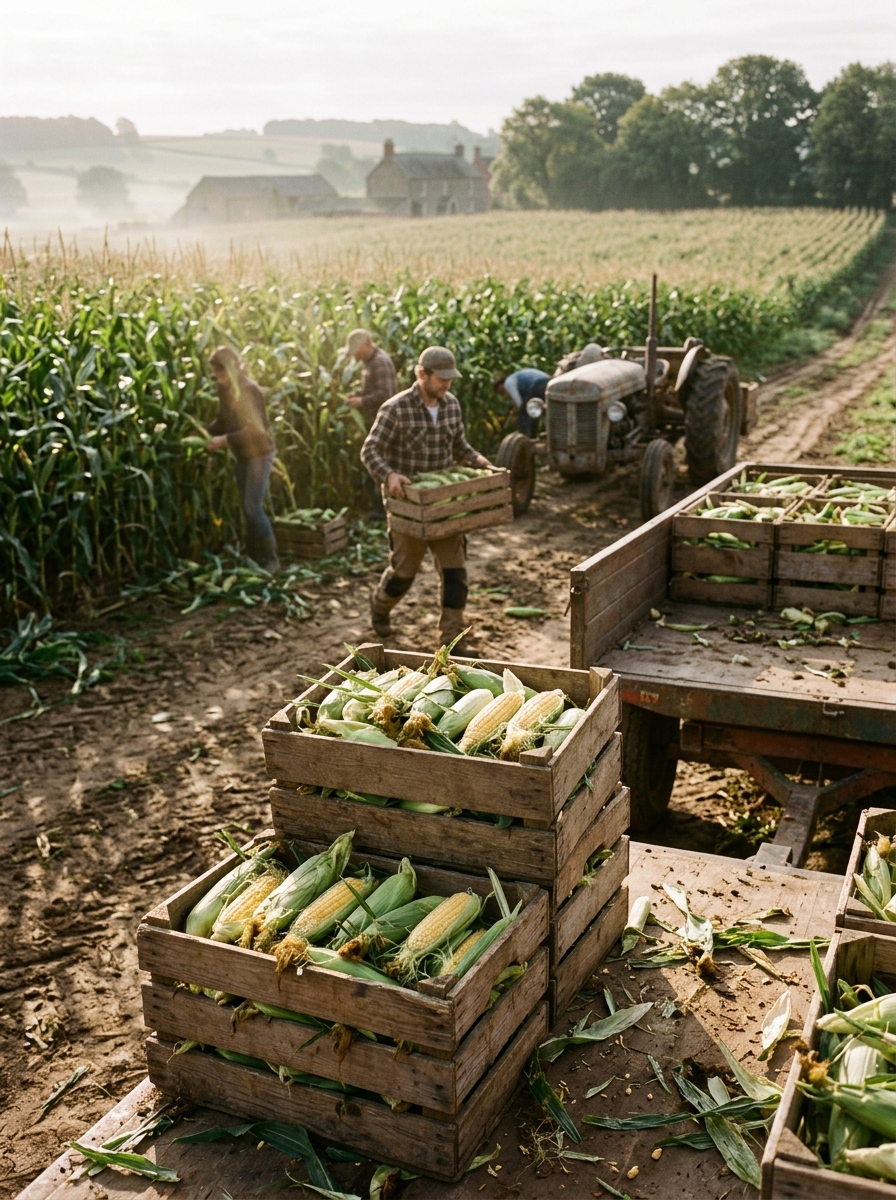
The 2026 European sweet corn processing season concluded with uneven regional outcomes. France, which alongside Hungary accounts for the bulk of continental production, registered lower gross harvests across southwestern departments due to precipitation deficits during critical vegetative stages. Hungary, by contrast, delivered a comparatively stable harvest but faced rising logistics and energy expenditures that exerted upward pressure on ex-works price quotes.
The overall European Union supply balance proved notably tighter than in the preceding two campaigns: processing facilities completed their runs with minimal carry-in inventory heading into the new marketing year, severely restricting price flexibility during 2027 forward contract negotiations. Processors in Poland and Spain handled smaller volumes, though their aggregate output remains marginal in the wider EU balance sheet.
2. Drivers: Weather Conditions, Production Costs, and Acreage Competition
The primary agro-climatic driver of the season was uneven moisture distribution between May and July. In France’s Aquitaine region, home to a substantial share of processing infrastructure, rainfall deficits during pollination and milk maturity directly hindered kernel development. This culminated in reduced field yields and delayed harvest schedules.
Simultaneously, processors confronted structural cost inflation: escalating energy costs for autoclaving, rising prices for tinplate steel used in can manufacturing, and elevated road freight tariffs. Several processing plants curtailed pack volumes, opting out of lower-margin contracts tied to previously fixed rates. This further tightened market availability and restricted spot volumes across the continent.

3. Market Mechanics: Why a Closed Processing Window Constrains Supply Flexibility
Sweet corn represents one of the few agro-industrial categories where processing is strictly governed by a narrow biological window: only a few hours may elapse between field picking and industrial autoclaving before natural sugars rapidly convert into starches, permanently degrading organoleptic qualities. Consequently, canning facilities cannot stockpile raw materials or extend their processing schedules — the entire annual supply is locked in within a 2- to 3-month field campaign.
This dynamic creates structural supply rigidity. If a plant under-processes due to weather shocks or raw material shortages, the deficit cannot be recouped in subsequent quarters. As a result, a 10–15% harvest contraction in a core production region translates immediately into a visible reduction in available finished goods inventory across wholesale markets.

4. Industry Response: Private Label Expansion, Vacuum Formats, and Contract Realignment
Supermarket retail chains responded to tightening supplies by enforcing stricter Private Label technical specifications and moving forward their annual volume contracting cycles. Concurrently, vacuum-packed sweet corn (Vacuum Pack) continues to register robust demand across the HoReCa and food processing sectors — driven largely by higher net drained weights without liquid brine, which optimizes freight costs and streamlines culinary processing.
Hungarian processors, buoyed by consistent harvest volumes, secured a competitive advantage, aggressively expanding their footprint into Central and Northern European markets and partially backfilling shortfalls in French deliveries. Procurement managers who historically relied exclusively on French suppliers are actively reassessing their supply diversification strategies for the upcoming season.
5. Analytical Assessment
Analytical Conclusion. The European canned sweet corn market concludes the 2026 campaign with minimal carryover reserves and a structurally tight supply-demand balance. Drought stress in France alongside elevated industrial operating costs underpin a moderate upward trajectory for ex-works prices in 2027 contract negotiations. Hungary solidifies its role as the primary flexible supply hub for Central and Eastern European buyers.
Practical Takeaway. For importers, supermarket retail chains, and food service operators, prevailing market fundamentals necessitate early volume commitments for 2027, as opportunities for spot procurement at legacy price points will remain severely constrained. Dual-sourcing between French and Hungarian packers mitigates supply security risks stemming from localized climatic volatility.
MIC-TRADE (International Food Trading Company) is an international trading enterprise specializing in the physical supply of food commodities and the development of commercial partnerships between producers and buyers across global markets. We manage international supply chains, source qualified manufacturing partners, harmonize product specifications, and oversee end-to-end export-import operations. Our focus centers on rigorous product compliance, industrial processing benchmarks, quality assurance, and commercial transparency. Review our full portfolio and product specifications in our canned sweet corn catalog. To explore supply opportunities, distribution arrangements, or international trade partnerships, connect with our team via our contact page.