

Pineapple Harvest Season in Thailand and the Philippines: Raw Material Deficit, Quality Shifts, and Canned Market Restructuring
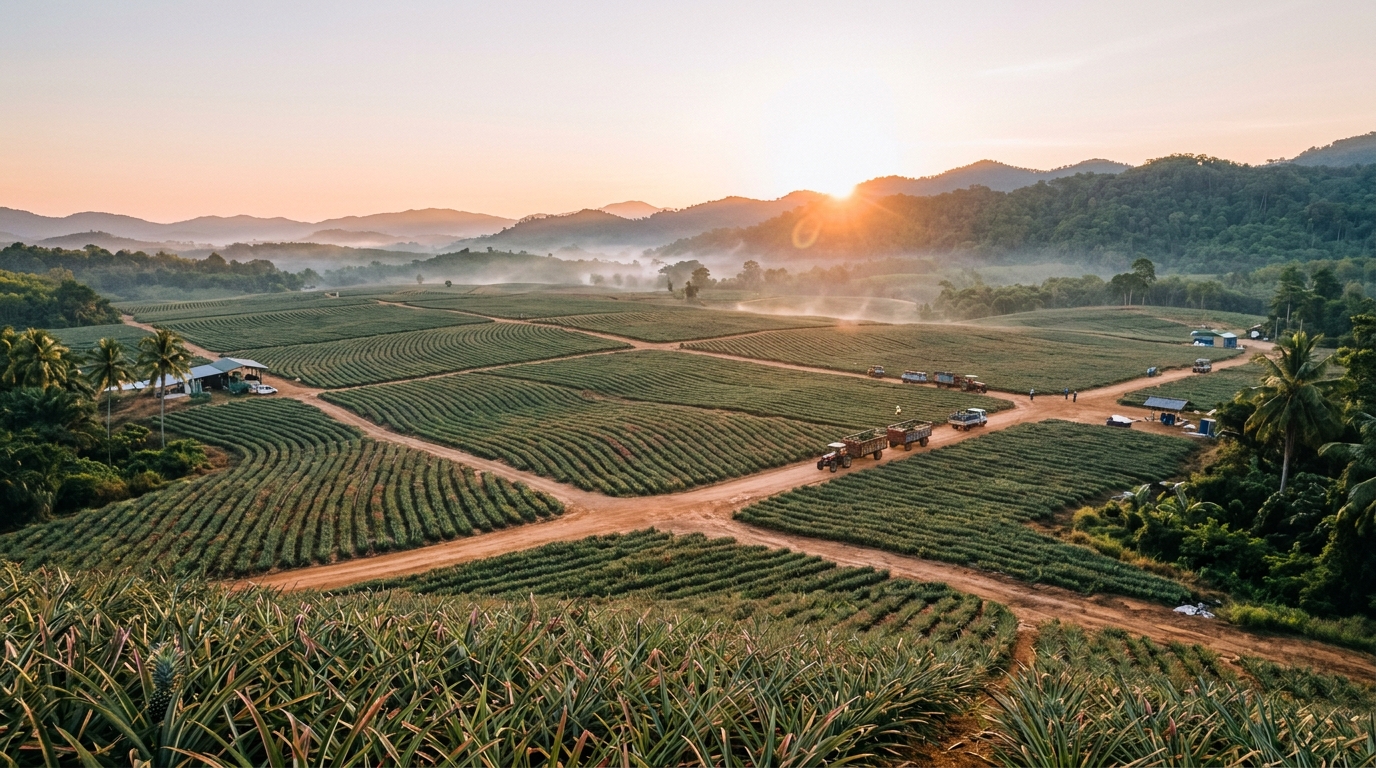
Current tropical pineapple harvesting seasons across Southeast Asia have exposed a pronounced raw material deficit between the region’s primary producers. As Thailand faces one of its sharpest production downturns in decades, the Philippines has maintained harvest stability and expanded fresh export volumes. This supply divergence is reshaping global canned pineapple balances, driving cut-structure shifts, intensifying competition with juice processors, and realigning international procurement frameworks.
The Fact and Its Scale: The Raw Material Gap Between Thailand and the Philippines
Thailand has historically accounted for up to 55–60% of global canned pineapple exports. Following the preceding harvest and current transitional season, domestic gross feedstock intake recovered to only approximately 850,000 tonnes. This volume stands substantially below historical averages of 1.8–2.0 million tonnes, remaining far below typical regional processing baselines.
The acute shortage of cannery-grade fruit triggered a 45–50% surge in factory-gate procurement prices and depressed cannery capacity utilization to 40–50% of nominal operational potential. This contraction significantly curtailed the physical supply of finished goods in international channels, pushing export contract price indices for canned pineapple up by 25–35%.
Conversely, the Philippines demonstrated strong agricultural resilience, maintaining consistent gross production levels. Over the recent annual cycle, Philippine pineapple export shipments climbed 19% to approximately 810,000 tonnes, allowing the country to secure nearly 22% of total global trade. However, the domestic sector’s heavy focus on the fresh market and table cultivars prevented Philippine volumes from fully offsetting the industrial processing deficit emerging from Thailand.
Underlying Drivers: Drought and Acreage Contraction in Thailand
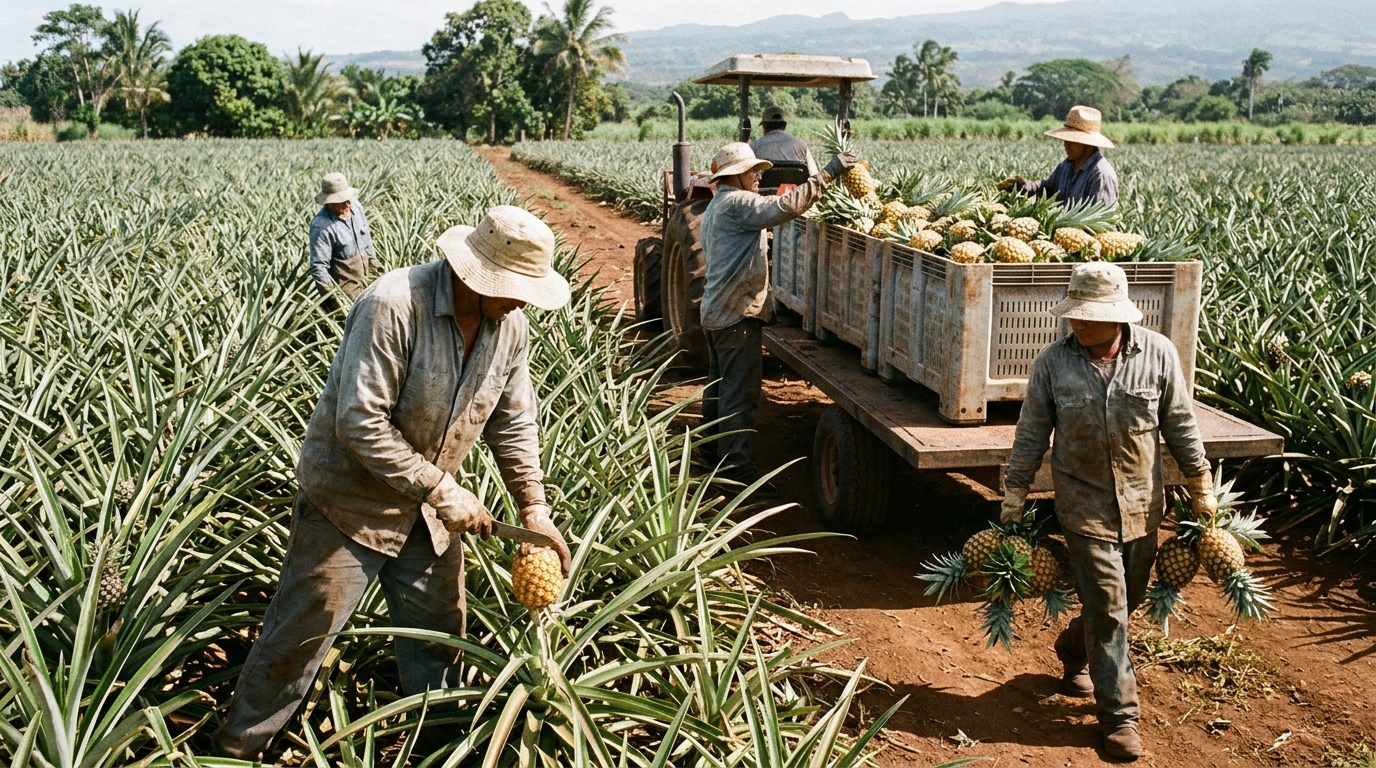
The primary trigger behind Thailand’s production drop was severe drought and temperature anomalies linked to El Niño climate patterns. The depletion of irrigation reservoirs across core agricultural provinces—notably Prachuap Khiri Khan and Rayong—coincided with critical flowering and fruit-bulking stages. Given the 14–18-month biological crop cycle of industrial pineapple, prolonged moisture stress caused both aggregate tonnage losses and a sharp decline in average fruit caliber.
Climatic strain accelerated an ongoing structural reduction in planted acreage. Thailand’s agricultural base relies predominantly on smallholder farmers. Following successive seasons of depressed margins and elevated fertilizer costs, many growers diversified acreage into hardier cash crops, such as cassava and rubber. Consequently, even as weather patterns normalized, productive acreage failed to return to pre-downturn benchmarks.
The Philippines sustained its production run rate due to a contrasting operational architecture built on large-scale, vertically integrated commercial plantations across Mindanao. Dedicated drip irrigation infrastructure, rigorous agronomical protocols, and targeted agricultural programs (securing inputs and crop protection) enabled estates to mitigate drought exposure and preserve projected yields.
Category Impacts: Caliber Distribution, Varietal Profiles, and Juice Sector Rivalry
For industrial processing, raw material value is dictated not only by gross tonnage but by fruit geometry and diameter. Standard premium canning slices (rings) necessitate large-caliber fruit with uniform core dimensions. Due to environmental stress, Thai canners received predominantly undersized fruit, reducing the pack-out yield of select slices by 15–25%. Processors were compelled to divert substantial fruit mass toward smaller cuts, such as chunks, tidbits, and crushed (pizza cut) pineapple.
Varietal profiles clarify why Philippine supply does not serve as a direct plug-and-play replacement for Thai raw material. The Thai Smooth Cayenne variety remains the global processing standard for retort canning due to its firm flesh structure, fibrous density, and balanced natural acidity. In contrast, the dominant Philippine MD2 variety features higher Brix levels and a softer cellular profile, requiring careful adjustments to canning media (juice or syrup formulation) to preserve contractual texture and organoleptic specifications.
This tight availability was exacerbated by intense cross-industry competition. A global deficit in frozen concentrated orange juice spurred beverage manufacturers to secure pineapple juice concentrate as an alternative blending base. Juice processors aggressively procured field-run fruit directly at the farm gate, frequently outbidding canned food factories and deepening the industrial feedstock squeeze for conventional canning lines.
Industry Adaptation: Shortened Contract Horizons and Geographic Diversification
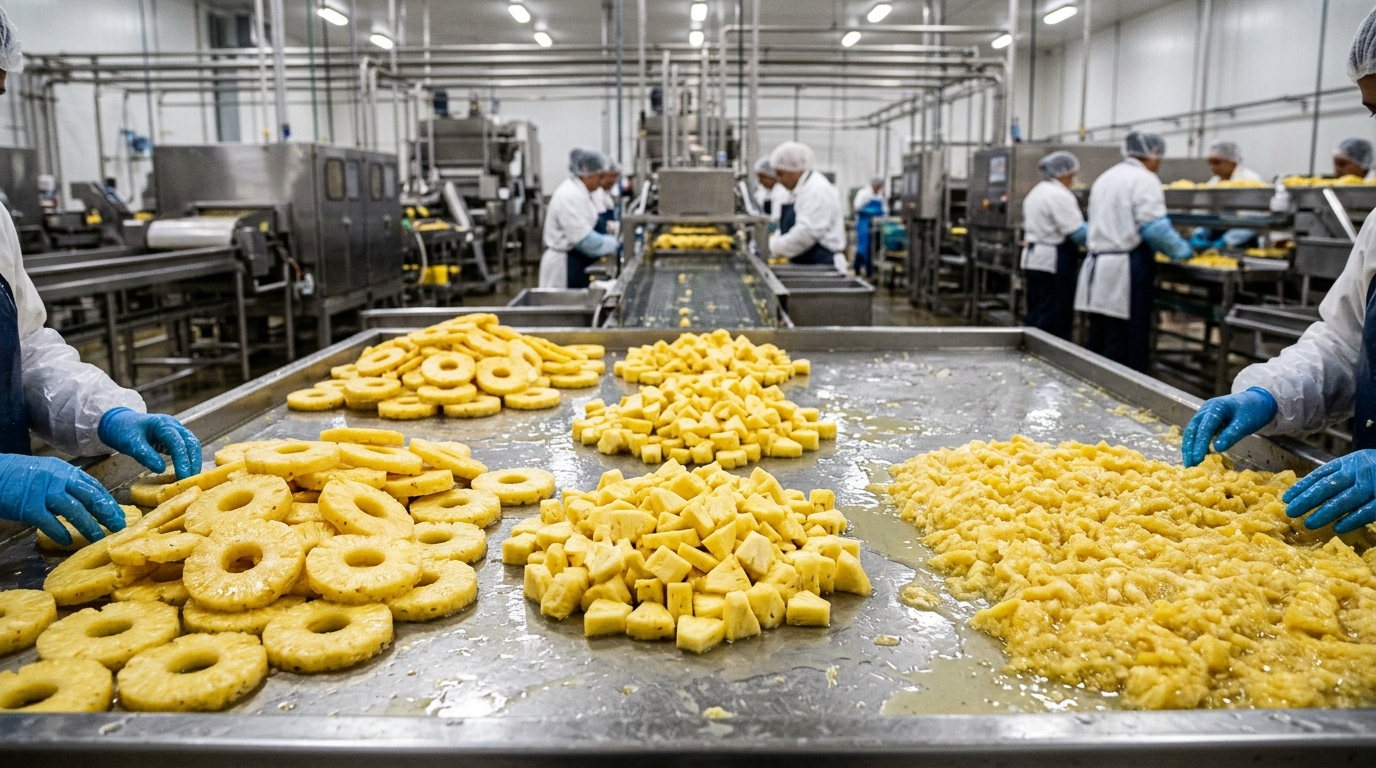
Fruit processing plants have fundamentally restructured commercial contracting frameworks. Long-term annual fixed-rate contracts have largely been replaced by quarterly purchasing arrangements governed by formulaic pricing indexed directly to farm-gate raw material indices. Packers optimized operational throughput toward chunks and crushed formats, minimizing process loss associated with off-spec calibers.
Global retail chains and food service (HoReCa) operators adapted procurement matrices accordingly. Supermarket private label programs expanded the shelf presence of chunks and tidbits to compensate for slice allocations. Food service distributors, commercial bakeries, and pizza manufacturers revised formulation sheets toward crushed pineapple and diced cuts packed in natural juice or light syrup.
Geographic diversification has accelerated across international trading desks. To reduce single-origin supply chain exposure to Thailand, institutional buyers and multinational processors increased forward allocations with Philippine packers while expanding procurement contracts with processing hubs across Indonesia and Vietnam to establish resilient multi-origin supply chains.
Strategic Outlook: Implications for International Buyers
Analytical Conclusion: The global canned pineapple supply balance will remain tight over the next 6–12 months, characterized by an acute scarcity of large-caliber sliced cuts. Although harvest yields in Thailand are stabilizing, a rapid return to historical production baselines is precluded by structural acreage attrition. Stable Philippine output provides partial relief, yet its fresh-market prioritization and sweeter varietal profile limit full operational fungibility. Core market pressures will center on slice shortages and persistent procurement friction from industrial juice compounders.
Actionable Takeaway: For commodity procurement teams, prevailing conditions mandate a pivot away from spot transactions toward extended forward planning horizons. Operational resilience hinges on multi-origin sourcing across Southeast Asia, dynamic recipe management favoring chunks and crushed cuts, and early locking of cannery production windows alongside detailed technical parameter alignment.
MIC-TRADE (International Food Trading Company): MIC-TRADE is an international food commodity trading company specializing in agrifood supply chain execution and expanding commercial linkages between processing plants and industrial buyers worldwide.
Our operations center on managing international supply chains, originating qualified manufacturing partners, structuring technical product specifications, and managing turnkey export-import operations. We place primary emphasis on exact grade criteria, compliance with international processing standards, systematic quality assurance, and commercial transaction transparency.
Review our complete commercial product catalog and grade specifications in the dedicated MIC-TRADE pineapple section. To review supply programs and trade execution capabilities, contact our trading desk via the contacts page.